Funding the finality reward: options and a recommendation
Stake-Weighted F3 Finality pays staked FIL a reward for signing finality certificates, and it leaves open where that money comes from. §5 of Stake-Weighted F3 Finality states the requirement and the four things the mechanism reads from whatever supplies it.
The pool needs about 100M FIL of income over thirty years. Two sources could carry it: a one-time transfer from the mining reserve, released on a fixed annual schedule, and a finality stream inside the FIP-0118 (Solstice) block-reward split. They trade against each other at close to one for one, across an option set running from a 48M FIL envelope with the deepest block-reward rebalance to 91M FIL with FIP-0118 left exactly as passed.
The recommendation is the reserve alone at the 91M FIL envelope, with FIP-0118 untouched. The reserve was set aside at genesis for new miner types and has never been spent, and paying finality from it leaves the block reward alone. Storage providers are already absorbing Solstice’s ramp from 95% down to 50%. Cutting deeper is the direction that pushes marginal sectors to terminate, which weakens the same consensus security the FIP exists to protect. And a reward that touches no one’s share creates no contest between storage providers and stakers over the split.
The reserve route is the largest total consensus spend in the set, running +38.8M FIL above today’s committed issuance curve over the first decade where the cheapest rebalance runs +10.9M. The rebalance rows therefore stay on the table, and the mix is a community decision.
The FIL minted per epoch does not change under any option here. FIL entering circulation falls every year under every option. Whatever the pool has not paid at the year-30 sunset is burned.
Numbers marked [re-check] are snapshots as of the dates given and have not been re-verified against the chain; items marked [needs precise spec] are deliberately left open. The model runs behind the figures are unpublished and available on request.
1. The requirement: about 100M FIL
The pool needs roughly 100M FIL of income over the program’s life, 90M to 97M across the option set below. Holding 80M FIL staked, the security level the activation gate reads (Stake-Weighted F3 Finality §6, and the level at which a third of the pool is a meaningful forfeit), for twelve years costs roughly that at the 3–5% return holders of comparable assets accept today. Less money buys a shallower pool held for fewer years. The figure is a strawman calibrated to those comparables [re-check: the comparable rates and the required return they imply], and it is the constraint every funding design has to meet.
The 100M figure comes from the payment path. Holding 80M FIL just above the 4.0% rate at which stakers start leaving costs about 4.0M FIL a year, and the design must ride there for nine in-window years inside the first decade. Add the year-1 payout of about 2.1M and the cost of also surviving a 5.5% required return, and the first decade of payments is 39M FIL. It is the same bill in every design examined, within a third of a million FIL: across six funding lanes the fitted first-decade payout is 39.2M FIL with a residual standard deviation of 0.29M. The second and third decades add the rest, and what the pool does not spend by the year-30 sunset burns.
What the offer has to beat, and what it has to stay inside. Custodial FIL products clear at 0.3–2%, and ~10% is where credit-risk-bearing FIL products have attracted supply. The ceiling is the modal gross staking yield among current proof-of-stake networks, 4.7–5.5%, against issuance across large networks that has converged to 1–4% of supply a year and is still falling [re-check]. Staking yields refreshed 2026-08-11 run from SUI at 1.44% and DOT at about 2.9% through NEAR 4.72%, TIA 5.18%, SEI 6.37%, APT 7.0% and INJ 7.15%, and staked share across a comparable set runs 23–69% with a median near 45%, so a design recruiting 80M FIL, under a tenth of Filecoin’s circulating supply, is asking for less participation than is routine elsewhere.
The posted rate opens under a 12% ceiling and settles at 4.0–5.0% while staked FIL holds the security level (Stake-Weighted F3 Finality §3), inside that band at both ends. Nothing in the design fixes the rate; the market sets it, and the model treats 5% as the central case with 5.5% and 6% as the stress rows.
The bet is the return the market requires. Every option holds 80M FIL staked for twelve contiguous years from year 2 at a 5% required return, and seven of those years at 5.5%. What must be true is that the marginal staker requires no more than 5.5%, because above it the band falls to zero in a single step rather than tapering (§4 below). Being wrong costs security rather than money, and the year-3 review described in §2 below settles the bet against the chain: a pool short of the activation threshold and not rising over the trailing year is the falsifying result.
2. What any funding design has to build
Whatever the source, the same machinery has to ship, and the constants are the only part that depends on the row adopted.
A reward-pool actor with two ledgers. A built-in actor with no controller, keeping an unreleased and a released ledger. Only the released ledger would be spendable, and only the released ledger is what the posted rate reads (Stake-Weighted F3 Finality §3).
A fixed release table. Part of the transfer would be released at the upgrade epoch and the rest by a fixed annual table, shaped like the year-over-year decline of the scheduled simple-minting curve. That is a closed form with no chain-state input, so the table would ship as a constant vector and the funding path would read no chain state. The table would have to spend the whole transfer across the thirty years; its values are strawman [needs precise spec], and the illustrative table below does not spend the whole transfer. Releasing the whole transfer at the upgrade epoch would post a launch rate of 19.9% instead of 12.0% in the worked scenario, and staked FIL would hold the 80M FIL security level for 11 years instead of 13. The annual table is what holds the opening rate down.
A ceiling written into the design. The adopted envelope would be a hard ceiling on the total committed from outside the simple-minting schedule, counting against it both the transfer and the share of stream income that derives from baseline minting (a fraction of a million FIL over 30 years at any of the amendment pairs in §3 below). The rest of the stream, 28M to 44M FIL over thirty years depending on the pair, is simple-minting money the protocol was going to mint in any case and sits outside the ceiling by construction. What bounds it is the year-30 sunset and the fact that the stream is a decaying share of a falling emission curve: it delivers less every year without anyone deciding to cut it.
Two conditions on supply accounting. Reserve FIL was minted at genesis and counts toward total supply already; it sits outside circulating supply until disbursed. Today’s clients compute reserve disbursement as the drop in the reserve’s balance, which would count the whole transfer as circulating on the day it moves. The calculation would have to be amended to subtract the reward pool’s unpaid balance, treating it as still reserved, network-version-gated in the shape FIP-0100 used for its reserve constants and identical in every client. Two conditions come with it:
- The netting would be defined on the pool actor’s whole unpaid balance, not on a reserve-sourced sub-ledger. Where the stream is exercised it credits block reward into the pool, and block reward already counts as mined the moment it is minted, so a netting term that covered only the reserve-sourced part would step circulating supply up at every stream credit and count the same FIL twice.
- Both new singletons, the reward pool and the staking actor,
would be added to the circulating-supply traversal. The
non-consensus RPC path walks the state tree against a hard-coded list of
singletons and errors on an actor it does not recognize, so without the
addition
StateCirculatingSupplyfails outright. This has no consensus effect; it is the number external dashboards read.
Under the amendment neither the transfer nor an annual release steps
circulating supply on the day it happens: each is a move between
balances that both sit outside circulation. Total supply and the 2B cap
are unchanged, circulating supply rises exactly as rewards are paid, and
the sunset burn nets to zero, because burned FIL never circulated.
Without the netting the transfer would count as circulating on the day
it moves, which is a consensus-visible error:
FilCirculating sets the initial-pledge lock target, so a
mis-stated figure moves per-sector pledge.
Two reviews and a sunset. A year-3 non-activation review, triggered if the activation conditions (Stake-Weighted F3 Finality §6) have never been met, and annually thereafter until they are. The failure it catches is a pool that recruits stake, pays for advisory certificates, and never reaches the level at which any of them binds. Year 3 rather than year 2: the pool crosses the threshold in year 2 at a 5% required return but not until years 3 to 6 in the stress cases the design is sized to survive, so an earlier trigger would fire on uptake that is slow rather than absent. It would report staked FIL at the review epoch, its change over the trailing twelve months, and cumulative reward paid to date, which separates a pool that has exhausted the capital available to it, and goes flat for years, from one held back by a high required return, which still climbs. [needs precise spec] the measurement window, and the trajectory test stated as a percentage change rather than a level.
Three outcomes would be available to it: continue unchanged; revise the constants by FIP, which is a network upgrade rather than a knob, and where lowering the activation threshold is a security decision to be re-priced against settlement volume; or wind down honoring accrued rewards, removing any stream entry, stopping new accrual at a published epoch, keeping the claim path open until accrued rewards are claimed or expire, and burning the remaining pool early. [needs precise spec] the accrual-stop epoch, the claim-expiry rule, and whether the early burn is authorized in advance or needs its own FIP.
A funding review at year 25, triggering earlier if the released pool falls below a set fraction of its launch level [needs precise spec]. It takes up the successor question, including whether fees can carry the reward, at whatever size the network has grown to by then. Its default is that payment stops, so a review that reaches no conclusion ends the program on schedule.
A year-30 sunset. Whatever the pool holds thirty years after the upgrade is burned, released or not, and any stream entry expires on the same date. [needs precise spec] the sunset epoch, the review-trigger constants, and where the review obligation is recorded.
The constants would be protocol constants. The transfer size, the release table, any stream weight record, the schedule constants and the sunset date would change only through a FIP and a network upgrade, because a runtime-tunable rate would put finality economics on a governance surface an attacker could reach. The exposure that comes with that is that the constants are chosen before the market has revealed its required return, and a schedule that brackets it wrongly keeps paying and accumulating without ever binding finality until a FIP corrects it, which is what the year-3 review exists to put in front of the network. Burning the remainder at the sunset converts an idle overhang into a supply commitment and gives that review a hard backstop.
Production precedent for the pool’s shape. Cardano (0.3% of remaining reserves per epoch), Polkadot (13.14% per year of the gap to its 2.1B cap, since March 2026), and Avalanche (minting from the gap to its 720M cap) all express a capped reward budget as a fraction of what remains. Each pays leader-election stakers from a reserve designed to last the network’s lifetime; the design here borrows the budget shape, adds depth pricing (which none of the three has), and differs in paying only finality signers from a pool that burns at a sunset.
The release table, illustrated
The release schedule for the worked scenario, in M FIL, in each year after the 30M released at the upgrade epoch. Each entry is the year-over-year decline of the scheduled simple-minting curve evaluated on the scenario’s 49.789M FIL transfer [needs precise spec: the final table for the adopted envelope, the epoch within each year at which the release lands, and the fixed-point representation].
| Year | 1 | 2 | 3 | 4 | 5 | 6 | 7 | 8 | 9 | 10 |
|---|---|---|---|---|---|---|---|---|---|---|
| Release | 2.0326 | 1.8985 | 1.6476 | 1.4678 | 1.2801 | 1.1956 | 1.0376 | 0.9244 | 0.8061 | 0.7529 |
| Year | 11 | 12 | 13 | 14 | 15 | 16 | 17 | 18 | 19 | 20 |
|---|---|---|---|---|---|---|---|---|---|---|
| Release | 0.6534 | 0.5821 | 0.5077 | 0.4742 | 0.4115 | 0.3666 | 0.3197 | 0.2986 | 0.2591 | 0.2309 |
| Year | 21 | 22 | 23 | 24 | 25 | 26 | 27 | 28 | 29 | 30 |
|---|---|---|---|---|---|---|---|---|---|---|
| Release | 0.2013 | 0.1881 | 0.1632 | 0.1454 | 0.1268 | 0.1184 | 0.1028 | 0.0916 | 0.0799 | 0.0746 |
The entries sum to 18.4391M FIL as tabulated (18.43919M exact), so on top of the 30M released at the upgrade epoch 48.4392M of the transfer is released over the 30 years and 1.3501M stays unreleased; that remainder and whatever the released ledger still holds are burned at the sunset. An adopted table would normalize the same shape to full spend, which is worth about one more year at or above the security level.
The worked scenario
One configuration produces every illustration here and the rate table
and curve in Stake-Weighted
F3 Finality §3: a 49.789M FIL transfer with 30M released at the
upgrade epoch, a 25% service cap, a 35% storage-provider floor, and the
constants spend_rate = 0.22 and
S_offset = 55M. It holds 80M FIL staked for 13 contiguous
years at a 5% required return, pays 83.6M FIL to stakers over 30 years
(against 76M to 79M on the option rows), and runs 12.6M FIL above
today’s committed curve over the first decade. It is a 50M-envelope
configuration of the reference lane whose cheapest configuration reads
44.0M at +8.54M (§4 below). A storage-provider floor above the service
cap would guarantee the storage side more than the service side may
take, and no package in §4 below places the floor above the cap, so the
pairing is an illustration. That same split is what puts its
first-decade figure below every option in that table but the cheapest.
How
the finality reward is paid for works it through end to
end.
3. Where the money could come from
The mining reserve
300M FIL was set aside at genesis for “future miner types that have yet to be determined,” with distribution left to the community through the FIP process. It holds ~283M FIL today [re-check: balance 282.93M], and no FIP has ever drawn on it.
A finality committee paid per signed certificate is a new miner type performing a new proven service, and FIP-0085 already defines the governance path: the reserve is a keyless account, so a disbursement requires a FIP and a network upgrade. Across the option set the envelope runs from 48M to 91M FIL against that balance, so between 17% and 32% of the reserve would move and the rest stays where it is. It would happen once, since an annual pull would need either a network upgrade every year or a standing privileged debit path out of the reserve, which is the thing FIP-0085 closed.
A finality stream inside the FIP-0118 split
FIP-0118 has the reward actor divide each block reward across an
ordered list of streams. A finality stream would be one more entry, last
in the list, taking whatever remains after the storage-provider
consensus share w1 and the service share w2,
exactly 1 − w1 − w2 every epoch, leaving 0 FIL of the
residue today’s rules burn across all 30 years. It funds finality out of
FIL the protocol was already going to mint, and every option that uses
it draws less from the reserve than the reserve-only option does.
Service is computed as if the stream were absent.
w2 is evaluated first, on its own schedule and its own
quarterly volume gates, and the stream takes what is left, so service
receives the same FIL with the stream as without it and what a cap
change itself costs service is the whole of the cost to service.
[needs precise spec] whether FIP-0118’s ordered evaluation
alone guarantees this, or whether subordination has to be stated as a
rule on the list.
At FIP-0118’s published values the stream has no room to work
in at all, so exercising it takes two amendments. The service
cap moves from 50% to 35% or 40% (W2_CAP from 0.50 to 0.35
or 0.40). Because service is computed first, its cap sets the stream’s
ceiling: at the storage-provider floor, every point of service
entitlement above the cap is a point the stream cannot reach. Service’s
quarterly volume gates below the cap would be unchanged. The
storage-provider consensus share then continues below Solstice’s 50%
floor, to 40%, 35%, 30% or 25%, leaving the published nine-quarter ramp
from 95% down to 50% untouched.
The stream earns nothing until the storage-provider share falls below one minus the service cap: the residue first turns positive in the eighth quarter counting Solstice’s activation as the first at a 35% cap, and in the ninth at 40%. On the modeled dates the published ramp’s 50% floor is reached in March 2029.
Each FIP-0118 stream carries a WeightRecord of the form
{v_start, slope, t_start, floor, cap} evaluated as
clamp(v_start + slope × (epoch − t_start), floor, cap), so
adding a stream is a write to that list. The finality entry is a flat
strawman record of 0.45 starting at the upgrade epoch, and because it is
last it takes min(0.45, 1 − w1 − w2), a residue that
reaches at most 0.40 under any amendment pair. It absorbs the whole
residue, leaving 0 FIL burned, only while FIP-0118’s volume gates pass;
if the gates stall, it also picks up residue today’s rules would
burn.
At the published ramp’s end a second record would take over for the
storage-provider share,
{v_start = 0.50, slope = −2.5pp per quarter, t_start = the end of the published ramp, floor = the adopted floor, cap = 0.50},
reaching 35% six quarters later, 30% eight, 25% ten. No
quarterly step is larger than one Solstice already commits to:
the worst quarterly fall in per-EiB consensus revenue across the whole
schedule is 12.44%, which is the published ramp’s own step, and every
continuation step is smaller because 2.5 points a quarter is half the
ramp’s 5. No quarter breaches a 15% guard.
The dependency runs one way. Without the FIP-0118 split there is no stream, and if FIP-0118 does not activate, or activates without the amendments, the mix falls back to the reserve-only option at its own envelope. FIP-0118 does not depend on anything here, and the stream is a list entry removable by the mechanism that adds it.
Every workable design needs a transfer
A design with no reserve transfer at all cannot reach the security level. Roughly 54,000 zero-reserve configurations were run. At a 35% service cap with the deepest rebalance modeled, zero of 1,440 configurations reach 80M FIL staked at a 5% required return in any year at all. Pushing to curves nobody would ship, a spend rate at or above 0.35 with a 25% service cap, touches 80M and holds it for at most six contiguous years, entering in years 4 to 7. No configuration anywhere reaches twelve.
The reason is timing. The stream is a flow: it peaks at 4.00M FIL a year in year 5 and then decays about 11% a year with simple minting. Holding 80M FIL at a 5% required return costs 4.00M FIL a year, permanently. A decaying flow cannot cover a bill that does not decay, and with no reserve the pool never accumulates a balance, so the posted rate never rises with pool depth.
The alternatives set aside
| Alternative | Why not |
|---|---|
| A different pair of launch constants | Two anchors fix spend_rate and S_offset
once the released pool at launch is chosen, and both bind in every
option: the 12% ceiling on the launch rate (Stake-Weighted
F3 Finality §3), and the rate the schedule posts while staked
FIL sits at or above the 80M FIL security level, 4.0–5.0% throughout
that run at a 5% required return, checked month by month, inside the
cross-chain band §1 above reports. In the worked configuration the pair
puts the launch rate at exactly 12.00%, and a rate sitting exactly on
the ceiling does not survive publication rounding, so the adopted pair
leaves headroom below it |
| A gated later draw alone — draw nothing from the reserve until the network has run a year below a set issuance threshold, and nothing ever if that year never arrives | The least contested design available, and it costs six years: with no stream income the pool cannot post a deep enough rate to fill early, and staked FIL does not reach the 80M FIL security level until around year 8 — six more years on the weaker fallback tolerance Stake-Weighted F3 Finality prices |
| A bootstrap premium — a separate tranche adding 3 percentage points to the offered rate for the first 36 months | The release schedule already pays early stake more than late stake: the rate opens in double digits while stake is shallow and falls to around 5% by the time 80M FIL is staked. The launch rate also leaves no room, since the constants sit against the 12% ceiling in every option, so a 3-point adder would open at 15% |
| A smaller baseline cap — reduce the 770M baseline cap and pay the pool from the difference | It cuts storage-provider reward from the first epoch, before the committee exists and before a single certificate is signed: baseline emission is proportional to the cap, so the baseline slice falls in proportion to the carve [re-check: today’s baseline slice runs ~3.1M FIL/yr] |
| A deeper cut to the block-reward split instead of a new fund | Each cut lowers storage-provider revenue against fee obligations that do not fall with it, which makes terminating sectors to recover pledge the rational response, and that removes quality-adjusted power. The loop is not modeled here, and the modeling is owed before any deeper cut is proposed |
| A larger reserve draw — take more than the requirement | Beyond the ~100M requirement the money buys years the program is not sized for, at worsening returns: 85M reaches the twelve-year bar, 100M buys fourteen years, and above that each additional FIL buys less time and more sunset burn, since whatever the market never claims is destroyed at year 30. A first disbursement also sets the terms of every later one, and FIP-0118’s own Design Rationale, at question Q3, treats the reserve’s finiteness as the reason to draw carefully. Every FIL paid out of a draw also enters circulation, so a larger transfer sits further above today’s committed curve |
| The withheld baseline — re-key effective network time to staked FIL and route withheld baseline emission to finality rewards | The largest available source and it needs no new fund, since the network sits far below its baseline target and most of the 770M baseline schedule is withheld. But a settled stake pool is static against an annually-doubling baseline target, so effective time crawls and the flow decays below the reward bill within roughly a decade. The baseline function is denominated in bytes with no natural conversion from staked FIL, so whatever constant is chosen sets the funding rate by fiat |
| A fixed 10% slice of the block reward | The simplest thing to ask for and the most expensive way to ask for it, in both constructions. Taking 10% of every stream’s share cuts storage-provider revenue a further tenth on top of the published ramp and breaches the 15% quarterly pace guard at every viable ship date (16.9–20.2%); none of 12,072 configurations clears the bar, and even guard-waived it prices at +28.7M of first-decade delta on a 98.8M envelope — more reserve than the reserve-only row draws. Taking 10% of the residue instead pays nothing under FIP-0118 as passed and reaches ten points only at a 40% service cap after the ramp ends, which is a ten-point cap concession by another name: it harvests 8.2M FIL in the first decade where the 40%-cap / 25%-floor package harvests 23.5M on the same concession, and a further 7.1M of its apparent discount is burned as unused residue. Ten points buys about 6M FIL of reserve relief however it is split |
| Release on need — release each year only what the pool is short of its launch level | Returns one more year at or above the security level at the central 5% case and defers about 5M FIL of first-decade issuance, but only if the market clears at 5% or below; above that the pool never rises far enough above its launch level to hold the security level at all |
Extending FilLocked to subtract staked
FIL |
It would improve the issuance picture further, and it is declined
because FilCirculating is a consensus input rather than a
reporting figure (§6 below) |
No option above changes minting: simple minting, baseline minting, the baseline target function, effective network time and the 2B cap all stay exactly as they are.
4. What the options cost, and who pays
Each row is the cheapest configuration of its source mix on the first-decade measure, and every row clears the same bar: twelve contiguous years at or above the 80M FIL security level at a 5% required return, entry by year 2, seven of those years surviving a 5.5% required return, launch rate at or below 12%, and falling issuance throughout. Two numbers are priced. Reserve envelope is the ceiling committed to on total draw from the mining reserve. First-decade delta is the cumulative FIL entering circulation above today’s committed curve over ten years.
| Source mix | Service cap | Storage-provider floor | Reserve envelope | First decade above today’s committed curve | Service entitlement given up, 10y / 30y | Storage-provider share given up, 10y / 30y |
|---|---|---|---|---|---|---|
| Reserve plus rebalance | 35% | 25% | 48M FIL | +10.9M FIL | 12.6M / 18.6M | 15.3M / 25.4M |
| Reserve plus rebalance | 35% | 30% | 55M FIL | +13.5M FIL | 12.6M / 18.6M | 13.0M / 21.1M |
| Reserve plus rebalance | 40% | 25% | 53M FIL | +15.5M FIL | 8.2M / 12.2M | 15.3M / 25.4M |
| Reserve plus rebalance | 40% | 35% | 67M FIL | +21.1M FIL | 8.2M / 12.2M | 10.2M / 16.3M |
| Mining reserve alone, FIP-0118 unamended — recommended | 50% | 50% | 91M FIL | +38.8M FIL | 0 | 0 |
The last two columns are what each constituency gives up against FIP-0118 as passed. The service cap alone sets the service column, which is why the two 35% rows share a figure and the two 40% rows share theirs; in every option that uses the stream, the storage-provider share gives up more than service does. The reserve-only option asks nothing of either and is the largest total consensus spend in the set.
At full precision, service-35 / floor-25 is the cheapest row that can be proposed at +10.88M on a 48.0M envelope, and the pure reserve the most expensive at +38.77M on a 90.75M envelope. Smaller envelopes clear the same bar at a higher first-decade cost: 42M FIL at 35/25, 48M at 35/30, 47.5M at 40/25, 58M at 40/35, and 85M FIL for the reserve-only design. No package offers a storage-provider floor above the service cap; the reference lane that does, service 25% / floor 35%, reads 44.0M of envelope at +8.54M of first-decade delta and +28.4M over thirty years.
The envelope ladder
Best first-decade delta at a capped envelope, in M FIL:
| Lane | Best delta at a 50M envelope | at 60M |
|---|---|---|
| Service 35% / floor 25% | +10.88 (cheapest anywhere, at 48M) | +10.88 |
| Service 35% / floor 30% | +14.62 | +13.54 (cheapest anywhere, at 55.4M) |
| Service 40% / floor 25% | +16.41 (at 48M) | +15.48 (cheapest anywhere, at 52.9M) |
| Service 40% / floor 35% | needs 58M | +23.11 |
| Pure mining reserve | needs 85M | needs 85M |
Service-40 / floor-35 reaches at most ten years at a 50M envelope and first reaches twelve at 58M. The pure reserve reaches 4 / 7 / 9 / 10 / 11 years at 50 / 60 / 70 / 75 / 80M and first reaches twelve at 85M. Capping the envelope at 50M costs delta in two lanes, and the extra cost is small: service 35% / floor 30% pays +14.62 against +13.54, and service 40% / floor 25% pays +16.41 against +15.48. Service 35% / floor 25% is unaffected, because its cheapest design already fits under 50M.
The cheapest-delta designs hold a large launch balance: the tranche released at launch is 53% to 81% of the envelope, which defers issuance by holding a large standing stock. Two measures therefore rank differently, and both are carried here. Minimum first-decade delta favors designs that hold a large launch balance; minimum envelope favors lean ones.
Each row’s constants, the pair spend_rate and
S_offset that set the posted rate, are strawman values,
lane-specific, and the release-table epoch and fixed-point
representation remain [needs precise spec] in every lane.
The launch date is a modeling input. Every figure here is computed on Solstice activating December 2026 and the finality upgrade one quarter later [re-check]; nothing here fixes when the work ships. Moving the launch later changes the first-decade delta by about 1.2M FIL in the lane where it matters most and by less elsewhere, and the latest launch date modeled still holds the 80M FIL security level for twelve contiguous years. Service-35 / floor-25 reaches +10.88M only at a 2028-04 launch, which spends the whole of its margin against a slipped ship date. At the common 2027-12 design ceiling it reads +11.25M.
Reserve draw against stream income
First-decade delta ≈ 39.2M FIL minus the stream income the pool receives through year 10. Fitted across all six lanes with the slope forced to −1: R² 0.999, residual standard deviation 0.29M. The identity is exact: cumulative issuance above today’s committed curve is payouts minus stream income, which holds to within 5 × 10⁻⁷ M FIL on every row, and the payout side is the same 39.2M bill everywhere.
The two knobs deliver at different rates. Through year 10 a point of service cap is worth about 0.97M FIL of stream income and a point of storage-provider floor about 0.55M, a ratio near 1.8 to 1, because cap concessions arrive while the stream peaks in year 5 while floor extensions phase in over 2029–2032. Against the envelopes above they price differently again: each point of service cap above 25% costs about 1M FIL of extra reserve draw, and each point of storage-provider floor about 1.4M to 1.5M. Requiring the design to survive a 5.5% required return for seven years costs about 3.0M FIL of first-decade delta, near-identical in every lane at 2.6–3.3M.
What storage providers see
During the nine-quarter ramp, nothing changes under any option. From Solstice activation to the end of its published ramp, the storage-provider share steps from 95% down to 50% on the schedule Solstice already commits to, and the service share is limited by the room the storage-provider share leaves rather than by its own cap. The cap and the floor only reallocate the split between service and the finality stream after the published ramp ends. Storage-provider revenue over those nine quarters is identical under every option, including the pure mining reserve.
After the ramp, the reserve-only option leaves the split untouched. Under the options that use the stream the floor continues to 40%, 35%, 30% or 25%, and in steady state per-EiB consensus revenue is 80%, 70%, 60% or 50% of what Solstice as passed would pay, one figure per floor, which is 40%, 35%, 30% or 25% of the no-split level.
The only option that stops at the 35% floor ships in December 2027, and over the 30 years from there storage providers receive 56.05M FIL of consensus reward against 72.32M under Solstice as passed; a deeper floor takes more. Thirty-year totals are not comparable across ship dates, since a later window opens further down a decaying schedule. The table tracks that option from its December 2027 launch, per EiB of raw byte power held flat at 1.398 EiB to make the ratios exact:
| Year | This option | Solstice as passed | No split at all |
|---|---|---|---|
| 1 | 7.67 | 7.67 | 11.60 |
| 3 | 3.41 | 4.46 | 8.91 |
| 5 | 2.46 | 3.52 | 7.04 |
| 10 | 1.37 | 1.96 | 3.93 |
| 15 | 0.77 | 1.10 | 2.20 |
M FIL per EiB per year.
Against that, storage providers are eligible for the participation reward as holders, and their block producers earn the includer share for submitting certificates.
The required return sets the band
Past 5.5% the band falls to zero in a single step:
| Required return | 5.00% | 5.25% | 5.50% | 5.75% | 6.00% |
|---|---|---|---|---|---|
| Band years, 35% cap / 30% floor | 12 | 10 | 7 | 0 | 0 |
| Band years, 40% cap / 35% floor | 12 | 9 | 7 | 0 | 0 |
| Peak staked, M FIL | 85–90 | 80 | 80 | 75 | 70 |
Seventy-five basis points above the modeled return, the pool still recruits 75M FIL, still pays those stakers from the first certificate, and never crosses the activation threshold, so no certificate ever binds. What is lost is the security objective the payment was for. Holding the envelope fixed at 55.5M FIL and re-choosing only the two curve constants against the market’s actual required return, the same money buys 11 band years at 5.75%, 9 at 6.5% and 7 at 7.5%. Repricing them is a FIP and a network upgrade, and in the interval the mechanism keeps paying, keeps accumulating, and does not bind.
The demand cases
The schedule is run at required returns of 3% and 5% on the worked scenario’s configuration. Staked FIL reaches the 80M FIL security level in year 2 in both and holds it for 13 contiguous years at 5% and 18 at 3%; payments peak at 4.89M FIL in year 6 and fall every year after, totalling 83.6M FIL over 30 years at 5% and 87.7M at 3%. Every funding option is sized against the same 5% central case at a twelve-year bar, so the arrival profile is common to all of them and only the pool balances differ. Both cases assume stake arrives at 5M FIL/month while the offered rate clears the return stakers require, exits only when the offered rate falls below 80% of that required return, 130M FIL of reachable idle capital, and no restaking of rewards. The 3% case is the likelier one given the acceptance band in §1 above and the largest storage-provider lending product’s 3.2% yield [re-check]; the 5% case is the modal gross yield among current proof-of-stake networks, if FIL stakers anchor on cross-chain rates instead.
Marginal staker requires 3%:
| Year | Staked | Posted rate | Released pool at year end |
|---|---|---|---|
| 1 | 60M | 5.70% | 29.8M |
| 2 | 120M | 3.74% | 29.8M |
| 3 | 130M | 3.65% | 30.7M |
| 5 | 130M | 3.86% | 32.4M |
| 10 | 130M | 3.36% | 28.2M |
| 20 | 75M | 2.44% | 14.4M |
| 30 | 25M | 2.44% | 8.9M |
Marginal staker requires 5%:
| Year | Staked | Posted rate | Paid that year (network-wide) | Released pool at year end |
|---|---|---|---|---|
| 1 | 60M | 5.70% | 2.3M | 29.8M |
| 2 | 80M | 4.89% | 3.9M | 30.0M |
| 3 | 85M | 4.96% | 4.1M | 31.6M |
| 5 | 95M | 4.99% | 4.8M | 34.0M |
| 10 | 100M | 4.32% | 4.5M | 30.4M |
| 20 | 45M | 3.99% | 1.9M | 18.1M |
| 30 | 15M | 4.09% | 0.6M | 13.0M |
Thin demand costs almost as much as full demand. The
pool pays spend_rate × P whatever depth it reaches, so a
market that delivers less stake does not spend proportionally less; it
pays a higher posted rate to fewer stakers. Measured across the demand
cases on the committed-curve baseline, at the 40% cap / 25% floor
row:
| Case | Peak staked | Above the curve, 10y | Above the curve, 30y | Per 1,000 FIL-years of stake, 30y |
|---|---|---|---|---|
| Required return 3% | 130M | 18.7M | 43.3M | 16.2 |
| Required return 5% (central) | 85M | 15.5M | 38.9M | 23.1 |
| Required return 6% | 70M | 13.5M | 36.6M | 26.8 |
| Reachable capital 60M | 60M | 12.3M | 38.7M | 26.7 |
| Reachable capital 40M | 40M | 7.7M | 37.6M | 33.1 |
Thirty-year spend varies by 13% across a 3.25× range in delivered stake, and the unit cost of security roughly doubles. In the 40M row the pool never reaches the activation threshold, so every certificate paid for over thirty years is advisory, and the bill is 97% of what full demand costs. The first decade runs the other way, 7.7M against 15.5M, because payouts fall while the release table does not.
Uptake is the largest open variable. Storage-provider lending products such as GLIF hold on the order of tens of millions of FIL [re-check: ~32M FIL TVL] supplied voluntarily for indirect, credit-exposed yield, and on other proof-of-stake networks native staking absorbs 30–60% of circulating supply [re-check]. Against circulating supply of 889.58M FIL at the 2026-07-17 capture [re-check], already net of locked pledge, the ~32M FIL of revealed preference is 3.6% and the cross-chain share would be 267M to 534M FIL. The 130M FIL of reachable idle capital the scenarios assume is 14.6% of circulating supply, between the two readings.
What the network spends on consensus, in total
Counting PoRep reward plus finality payouts over thirty years on one aligned window, the network spends 72.3M FIL under Solstice alone and 123.3M to 148.9M with a finality reward funded from this set: 46.9M to 72.3M of storage-provider consensus share plus 0 to 44.1M of finality stream, with 48M to 91M drawn from the reserve making up the balance and the sunset burning whatever is never paid. Finality payouts land at 76M to 79M whichever mix is adopted, because the pool’s income constraint binds and the sunset burns the difference. The source mix moves who pays that bill, and the reserve-only option carries the largest total, 148.9M. In share terms, the rebalance rows move the steady-state split back to 65% consensus at a 35% service cap, or 60% at a 40% cap.
5. The recommendation
The mining reserve alone, at the 91M FIL envelope, with FIP-0118 left as passed.
It needs neither amendment to FIP-0118: the service cap stays at 50%, the storage-provider share stops at Solstice’s published floor, and nothing in the block-reward split moves.
The reserve was set aside at genesis for new miner types and has never been spent, and a finality committee paid per signed certificate is a new miner type performing a new proven service. Paying finality from it asks nothing of either constituency. The rebalance has two costs the reserve route does not pay. It creates a constituency, storage providers against stakers, live from the upgrade epoch whether or not a single FIL is ever staked, because the continuation of the consensus share starts on its own schedule. And it deepens the consensus cut: consensus revenue falling against fee obligations that do not fall with it makes terminating sectors to recover pledge the rational response, which removes quality-adjusted power and lowers the same consensus threshold the mechanism exists to raise. That loop is unmodeled, and the reserve-only row does not enter it.
The reserve also uniquely supplies income fixed at the upgrade epoch. It does not depend on FIP-0118 activating, on its quarterly volume gates passing, or on the emission path a stream decays with.
Its price is the largest in the set on every money measure: a 91M FIL envelope, 32% of the reserve, +38.8M FIL above today’s committed curve over the first decade where the cheapest rebalance runs +10.9M, and the largest total consensus spend of any option, 148.9M FIL against 123.3M at the deepest rebalance. Paying it avoids a renegotiation with either constituency and a deeper cut, and a negotiation cannot price either one.
The bar is twelve years at the security level at a 5% required return. The 91M row meets it, and carries the same seven-year margin at 5.5% that every row does. Above the modeled return the rebalance rows degrade more slowly, so at higher required returns they close the gap.
Approving a first disbursement sets the precedent that the reserve can be spent by FIP. The precedent is bounded to one event, a ceiling on the envelope, a bounded payment speed, a calendared review, and a sunset that burns the remainder. Its size, 91M FIL, is the largest single question the recommendation puts to the community.
The rebalance rows stay on the table. They cost less on envelope and on first-decade delta, they clear the same bar, and the machinery in §2 above is the same either way: only the constants change.
6. What it does to supply
Issuance falls every year under every option in the set. Under the netted circulating-supply definition in §2 above, FIL entering circulation is lower in every year than in the year before it, at both modeled required returns; the float still grows every year, by less each time. At a 40% service cap, ten of 42,198 runs that reach the security level show a rising year, and none of them is the cheapest in its cell; no feasible pure-reserve design with twelve held years has a rising year at all.
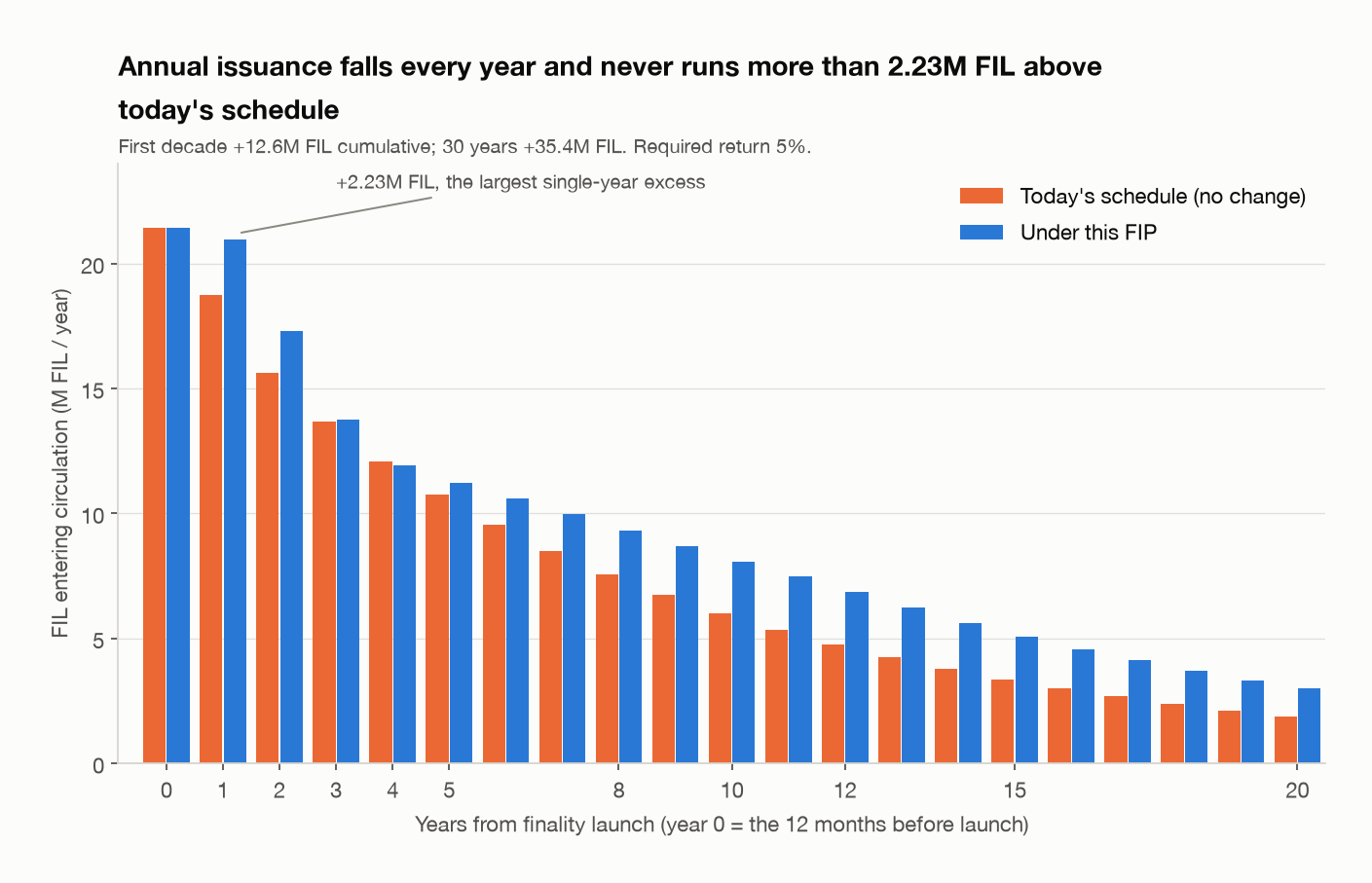
Drawn for the worked scenario, where the path never runs more than 2.23M FIL above today’s committed curve.
On the total-supply ledger the program adds nothing at all: the reserve transfer is genesis-minted FIL, a stream re-weights FIL that was already going to be minted, and the sunset burn reduces eventual total supply by whatever the market never claims.
The gross ledger charges the design with every FIL it pays, staked stock less cumulative payouts. M FIL, at the 40% cap / 25% floor row:
| Year | 1 | 2 | 5 | 10 | 15 | 20 | 25 | 30 |
|---|---|---|---|---|---|---|---|---|
| Required return 5% | +58 | +74 | +67 | +46 | +9 | −26 | −48 | −62 |
| Required return 3% | +58 | +114 | +110 | +88 | +55 | −1 | −37 | −56 |
The compression peaks at +74M (5%) or +119M in year 3 (3%), crosses zero in year 17 or year 20, and ends between −56M and −64M across the rebalance and reserve-only rows; the sunset burn of 13.9M to 16.4M FIL of unpaid pool moves those terminal figures to between −42M and −48M. On the rebalance rows most of what that ledger charges was going to be minted and circulate anyway: 37.7M of the 76.5M paid over thirty years is block reward the stream re-routes.
The committed-curve ledger counts only what today’s schedule would not have produced, and it is the baseline every table in §4 above uses. Its permanent addition is an identity, reserve drawn less the sunset burn, 38.9M FIL:
| Year | 1 | 2 | 5 | 10 | 15 | 20 | 25 | 30 |
|---|---|---|---|---|---|---|---|---|
| Required return 5% | −58 | −76 | −78 | −70 | −40 | −8 | +11 | +24 |
| Required return 3% | −58 | −115 | −121 | −111 | −86 | −34 | +1 | +18 |
On that measure the float is compressed for 21 years at a 5% required return and 24 at 3%, and the program ends with +18M to +24M FIL more in circulation than if it had never run. The source mix changes how far above today’s committed curve the path sits: +10.9M to +38.8M FIL over the first decade across the option set, and +32.3M to +76.6M over the thirty. In the worked scenario the largest single-year excess is +2.23M FIL, in year 1, no later year comes within 0.10M of it, and year 4 runs 0.17M FIL below today’s committed curve. All of these depend on the netting condition in §2 above: without it the transfer lands as a single step of its own size in year 1, both excesses become that number, and the comparison against today’s committed curve no longer holds.
Locked stake is reversible in a way a burn is not. If stake exits the compression unwinds, and the rate rises as it goes, drawing replacement stake back. That response re-recruits from the reachable pool rather than creating one, which makes it weakest in the deep-participation case the design treats as success.
Why staked FIL stays in circulating supply
FilCirculating is a consensus input rather than a
reporting figure, and that is the decisive reason for leaving staked FIL
inside it against an issuance picture that would look better without it.
It reaches the actors as rt.total_fil_circ_supply(), and
the miner actor sets the initial-pledge lock target at 30% of it (monies.rs,
LOCK_TARGET_FACTOR_NUM/DENOM = 3/10), so subtracting staked
FIL would lower per-sector pledge and couple the finality-stake market
to the storage-collateral market. On ETH, SOL, ADA and ATOM the
circulating figure is reporting only, so no other chain faces this
consequence.
The reporting convention points the same way. No major aggregator subtracts staked tokens, and staked tokens count as circulating everywhere else: Ethereum has 34.9% of supply staked against an excluded pool of zero, and Injective reports circulating supply exactly equal to total supply, 100,000,000 INJ, with 59.47M staked.
Filecoin’s own number behaves differently, which is why the change
would reach the reported figure. FIL’s publicly reported circulating
supply tracks the protocol’s FilCirculating, which nets out
pledge collateral: at epoch 6,275,948 the protocol reports 903.13M FIL
while CoinMarketCap and CoinGecko both report 819.16M [re-check:
snapshot at epoch 6,275,948, 2026-08-13]. The metric would also
become hostage to staking flows, so an unbonding wave would print a year
in which reported issuance rose.
The staking lock ships instead as what it is: a liquid-float line, circulating supply minus staked FIL, the same treatment dashboards give ETH and SOL staking. Pledge collateral has roughly halved in a year, from 127.79M FIL in August 2025 to 65.40M at the same snapshot.
7. What the numbers assume
The model has no price, no restaking or compounding, no delegation,
and no distribution over required returns. Capital arrives at a fixed 5M
FIL per month up to a 130M FIL ceiling, in 5M FIL steps, so a
single-step difference between two nearby configurations is quantization
rather than a result. Raw byte power is held flat at
rbp.start = 1.398 EiB, which is an
assumption rather than a forecast, and no per-EiB figure derived from
these runs should be quoted without replacing it. Each required-return
figure is one case run end to end; none carries a probability.
Every published row reproduces from its stated configuration. The two infeasibility results in the envelope ladder and the zero-reserve impossibility in §3 above carry a disproof one rung below the stated threshold.
8. Open decisions
| Decision | What turns on it |
|---|---|
| The funding source mix and the envelope | A five-row option set with published band-years and deltas; the recommendation here is the reserve-only row, and which row is adopted is open |
| The ~100M FIL pool-income requirement | Sized against comparables; the required return is the input it is most sensitive to |
| The release-table values for the adopted envelope | Worth about one band year; bounded by the full-spend rule |
| The depletion trigger and the review-trigger constants, and whether a termination-flow trigger joins the depth and activation triggers | Decides whether a slow decline trips a review before year 25; a termination-flow trigger is measurable, since terminations, the fee burn and staked balances are all on chain and only the join between an owner and a staker is not |
| Wind-down semantics: the accrual-stop epoch, claim expiry, and whether the early burn is authorized in advance or needs its own FIP | Sets what a non-activation review can actually execute |
| What FIP-0118 does with the weight a stream releases at the sunset or at a wind-down | Falls due on FIP-0118’s side, on this schedule |
| Whether FIP-0118’s ordered evaluation alone subordinates the stream to service, or the rule has to be stated on the list | Decides whether service can be affected by the stream at all |
| The sunset epoch and where the review obligation is recorded | Bounded: the date is thirty years from the upgrade |