How the finality reward is paid for
A companion to the draft FIP Stake-Weighted F3 Finality, which specifies the mechanism (the staking actor, the stake-weighted committee, certificate-gated rewards, slashing, and the activation gate), and to the funding analysis Funding the finality reward: options and a recommendation. The FIP leaves the funding source open; the analysis explores the options and recommends one. This covers one question: where the FIL that pays finality signers comes from, and what each option costs the people already being paid.
Constants marked [strawman] are chosen to make the design work; items marked [needs precise spec] are unresolved.
1. What changes
Finality signers are paid a posted rate on their staked FIL. Paying them takes about 100M FIL of income to a reward pool over thirty years, 90M to 97M across the options in section 2. Two sources could supply it, neither of them new minting.
One is required: a one-time transfer from the mining reserve, capped at an envelope the design commits to, which reaches the reward pool on a fixed schedule and enters circulation only as stakers are actually paid. The transfer can carry the whole program on its own, and that is what the analysis recommends.
The other is optional: a finality stream inside the Solstice block-reward split, opened to shrink the transfer. It is paid out of block reward that FIP-0118 (Solstice) as passed would pay to service and to storage providers. The service entitlement is Solstice’s share of block reward for network services other than storage-provider consensus; opening the stream caps it below its published 50%, and continues the storage-provider consensus share below Solstice’s 50% floor at half the pace of the ramp Solstice already publishes. What those two amendments leave unclaimed, the residue under the two shares, is what the stream is paid.
How much comes from each source is open. The two trade against each other almost exactly: opening the stream deeper means a smaller draw on the reserve, and leaving FIP-0118 untouched means a larger one. The preferred option is the 91M FIL envelope with FIP-0118 as passed; the deepest rebalance brings it down to 48M FIL. Section 2 gives the reasons.
Simple minting, baseline minting, the baseline target, and the 2B total-supply cap are untouched under every option. So is falling issuance: FIL entering circulation is lower every year than the year before, in every option and at both modeled required returns. The float still grows each year, by less each time.
2. Where the money comes from
Nothing is minted. The pool needs roughly 100M FIL of income over the program’s life, 90M to 97M across the options below, which is what holding 80M FIL staked for twelve years costs at the 3–5% return holders of comparable assets accept today. Two sources could supply it. The required one is a one-time transfer from the mining reserve. The optional one is a finality stream inside the Solstice split, opened by amending FIP-0118, which shrinks the transfer.
The transfer is required because a stream on its own cannot work at any curve: the stream is a flow that peaks near 4M FIL a year and then decays, while holding 80M FIL at a 5% required return costs 4M FIL a year indefinitely. The stream also pays little in the first years after the upgrade, which are the years the offer has to recruit stake, so the transfer carries them under every option.
The analysis recommends the reserve on its own. The reserve was set aside at genesis for new miner types and has never been spent, and finality signers are a new type doing new work. Paying signers out of the reserve leaves the block reward alone. Storage providers are already partway through Solstice’s ramp from 95% down to 50%, and cutting deeper is the direction that pushes marginal sectors to terminate, which removes the storage power the network’s security rests on. A reward that takes nothing from anyone’s share also leaves storage providers and stakers with no contest over the split.
That costs money. The reserve on its own is the biggest draw, and the most the network spends on consensus in total. It runs +38.8M FIL above today’s committed curve over the first decade, where the cheapest rebalance runs +10.9M. The rebalance options stay on the table for that reason, and which mix is adopted is a governance decision.
Every option below meets the requirement. They differ in how much reserve FIL is committed and in how much FIL enters circulation over the first decade above today’s committed curve, and the two move together.
| Service cap | Storage-provider floor | Reserve envelope | First decade above today’s committed curve |
|---|---|---|---|
| 35% | 25% | 48M FIL | +10.9M FIL |
| 35% | 30% | 55M FIL | +13.5M FIL |
| 40% | 25% | 53M FIL | +15.5M FIL |
| 40% | 35% | 67M FIL | +21.1M FIL |
| 50%, unchanged — preferred | 50%, unchanged | 91M FIL | +38.8M FIL |
Each row holds 80M FIL staked for twelve consecutive years from year 2 at a 5% required return. For any row, a smaller envelope works at a higher first-decade cost: the smallest that still clears the bar is 42M FIL at a 35% cap with a 25% floor, then 48M at 35/30, 47.5M at 40/25, 58M at 40/35, and 85M for the last row. Every FIL the stream delivers in the first decade is a FIL the reserve does not have to release, so the first-decade column falls one for one with what the stream brings in. The envelope column moves further, 48M to 91M against +10.9M to +38.8M, because part of every envelope sits in the pool rather than entering circulation in the first decade.
The floor is never set above the cap. The analysis does not offer a package whose storage-provider floor exceeds the service cap, since it would guarantee the storage side more than the service side may take.
The last row has no stream at all. At FIP-0118’s published 50% cap the residue never grows enough to recruit stake, so there is nothing worth paying a stream and the transfer carries the whole bill: 91M FIL, about a third of the reserve.
One rebalance scenario is worked through end to end in the numbers that follow, a 25% service cap with a 35% storage-provider floor: a 49.789M FIL transfer and the rate constants 0.22 / 55M. That pairing is not one of the options above, because it puts the storage-provider floor above the service cap, and that split is also what puts its first-decade figure below every proposable option’s but the cheapest. The preferred row looks different: a larger transfer and no stream, at the figures the funding analysis carries. It illustrates the mechanics: how the posted rate moves with depth and with the pool, what the release schedule does to the opening rate, and what the quarter-by-quarter path looks like on the storage-provider side. Unless a figure says otherwise, sections 3 to 5 are that scenario.
The required return is the yield below which a holder leaves their FIL unstaked; this document models 5% as the central case and 3% as the favorable one, and nothing in the design fixes it — the market does. The 80M FIL security level is the pool depth at which a one-third coalition must put about 27M FIL of slashable capital at risk, which is the security level the mechanism FIP’s activation gate uses.
At a 5% required return the pool pays stakers 83.593M FIL over thirty years. At 3% it pays 87.728M. The largest single year is 4.890M FIL, in year 6, and payments decline after that.
The reserve ledger, in the worked scenario. The shape is the same under every option; the figures move with the envelope.
| Line | M FIL |
|---|---|
| Reserve envelope, the cap the worked scenario commits to | 50.000 |
| Set aside for stream income that comes from baseline minting | 0.211 |
| One-time transfer at the upgrade epoch | 49.789 |
| Spendable in the pool at launch | 30.000 |
| Released by the annual table, years 1–30 | 18.439 |
| Total released over thirty years | 48.439 |
| Never released, burns at the year-30 sunset | 1.350 |
| Pool balance left at year 30, burns at the sunset | 13.012 |
| Total burned at the sunset | 14.362 |
A small share of the stream’s income comes from baseline minting rather than simple minting. The design counts everything that is not simple minting against the same envelope limit, so 0.211M is set aside for it here and the transfer is 49.789M rather than a round 50M.
For context, the mining reserve holds 282.93M FIL. Across the option set the envelope is 17% to 32% of it.
The transfer and the annual releases move FIL between two balances that both sit outside circulating supply, so neither steps circulating supply on the day it happens. Circulating supply rises only as the pool pays a staker, which requires the reserve-disbursement amendment the funding analysis recommends.
Against Solstice as passed, which is a different baseline from today’s committed curve, the worked scenario puts 33.56M FIL more into circulation over the first decade and 67.39M more over thirty years. Against the same 35% floor and 25% cap with no pool at all, the difference is exactly the payments to stakers: 43.15M over the first decade and 83.59M over thirty years.
What the numbers assume. They come from a model with no price, no restaking or compounding, no delegation, and no distribution over required returns. Each required-return figure is one case run end to end. Capital arrives at a fixed 5M FIL per month up to a 130M FIL ceiling, in 5M FIL steps, so a single-step difference between two nearby configurations is noise. Unless a figure says otherwise it is the 5% required-return case, with the 3% case shown alongside. Two conventions carry through the charts in section 4: the pool is one balance, so any split of payments between the reserve and the stream is an attribution by cumulative inflow rather than a traced flow; and per-EiB figures hold raw byte power flat at 1.398 EiB, which is what makes the steady-state ratios exact.
3. The timeline
Dates below assume Solstice activates on 2026-12-01 and finality launches one quarter later. Everything is anchored to activation, so if activation moves, every date moves with it. The storage-provider floor shown is the worked scenario’s 35%; a deeper floor takes two more quarters at 30% and four more at 25%, and under the reserve-only option the continuation never starts.
| Milestone | Quarters from activation | Date | Storage-provider share |
|---|---|---|---|
| Activation | 0 | 2026-12-01 | 95% |
| Finality launch | 1 | 2027-03-01 | 90% |
| End of Solstice’s published ramp | 9 | 2029-03-01 | 50% |
| Continuation begins, at 2.5pp per quarter | 9 | 2029-03-01 | 50% |
| Final floor | 15 | 2030-09-01 | 35% |
Solstice’s published ramp moves the storage-provider share 45 percentage points over nine quarters, 5 points a quarter. The continuation moves the remaining 15 points at 2.5 points a quarter, half that pace, and takes six more quarters. There are two floor dates because there are two floors: the published 50% floor lands 2029-03-01, two years after finality launches, and the 35% floor lands 2030-09-01, three and a half years after launch.
Where the stream is opened, the service share is computed as if it were absent and is never reduced by it. The stream takes only what is left. At a 35% floor the residue never exceeds 40% of block reward, so the stream is limited by the room available from the first quarter, and no block reward goes unallocated in any of the thirty years.
Stake reaches the 80M FIL security level at the end of year 2 after launch under every funding option, and stays at or above it for at least twelve consecutive years at a 5% required return. In the worked scenario the run is thirteen years, through year 14; at a 3% required return it is eighteen. The thirteen-year figure is checked month by month, not only at year ends: inside the window stake never dips below 80.0M FIL and the posted rate never leaves 4.001–4.997%. The mechanism FIP’s activation threshold, which decides when finality certificates start deciding which chain is final rather than only advising, is proposed at this level; its final value is open.
4. What the model shows
Every chart in this section is the worked scenario: a 49.789M FIL transfer, a 25% service cap and a 35% storage-provider floor. The shapes carry across the rebalance options; the levels move with the envelope. Under the recommended option there is no stream and no continuation below 50%, so the two block-reward charts have no counterpart there.
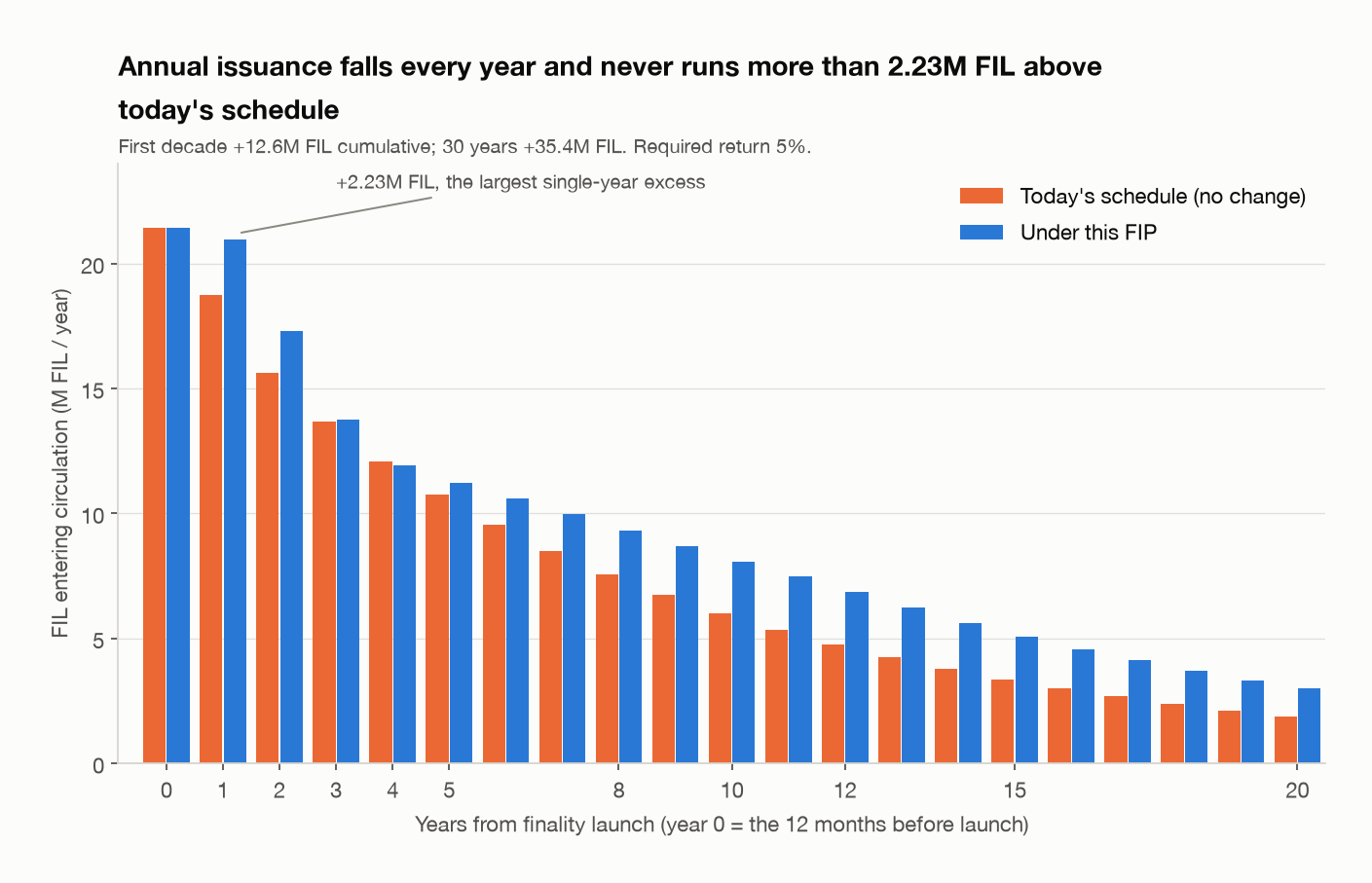
FIL entering circulation falls every year, under every option. In this scenario it never runs more than 2.23M FIL above today’s committed curve, cumulatively +12.61M FIL over the first decade and +35.43M over thirty years. Across the option set those cumulative figures run +10.9M to +38.8M for the first decade and +32.3M to +76.6M for the thirty years. The worked scenario sits below all but the cheapest of them because its storage-provider floor is above its service cap.
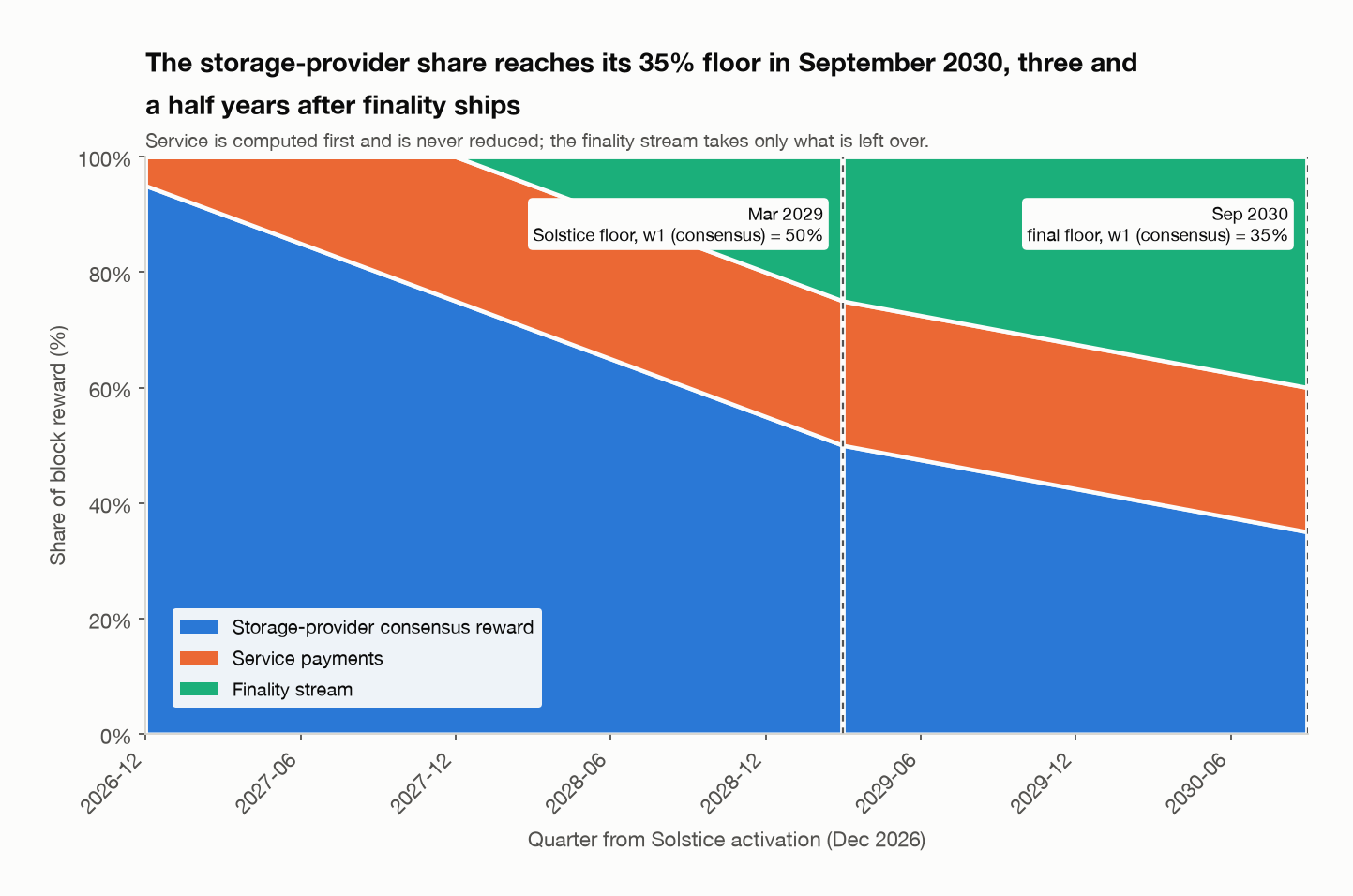
The storage-provider share steps down to 50% in March 2029 and to its 35% floor in September 2030, and the finality stream takes only the residue the other two shares leave.
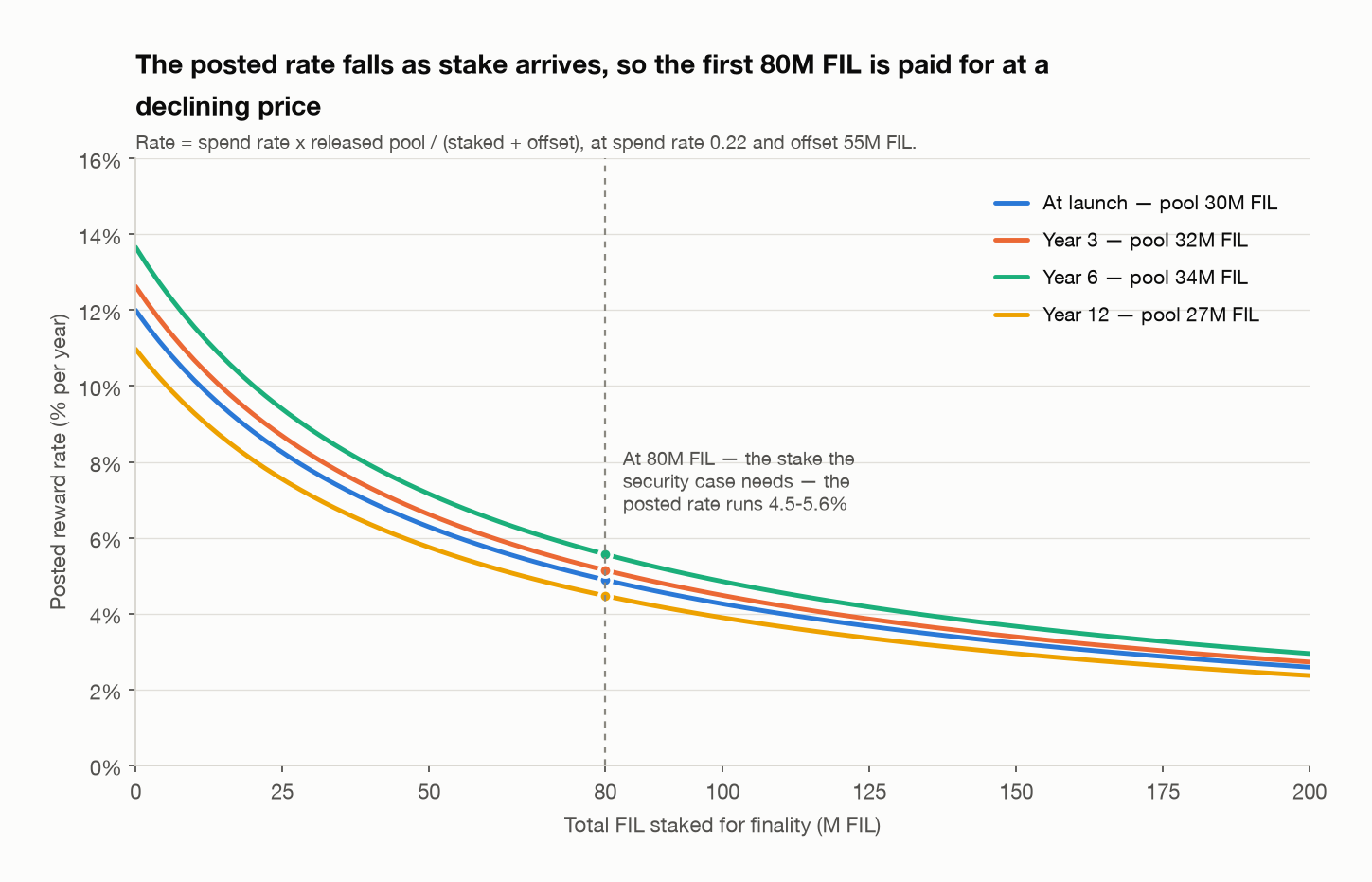
The posted rate falls as stake arrives, so the first 80M FIL of security is bought at a declining price rather than at one fixed rate.
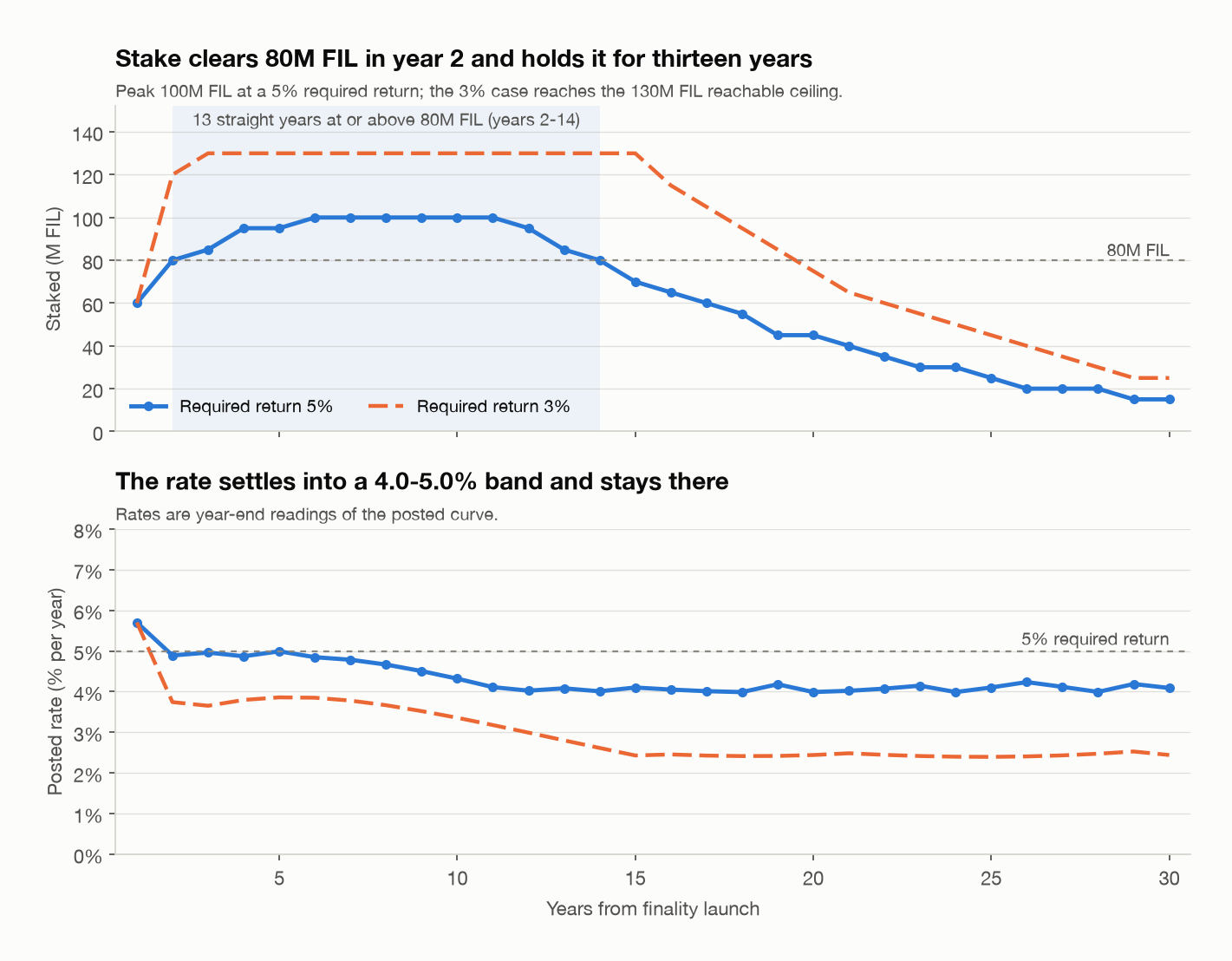
Stake clears 80M FIL in year 2 and holds it for thirteen years while the posted rate settles into a 4.0–5.0% band.
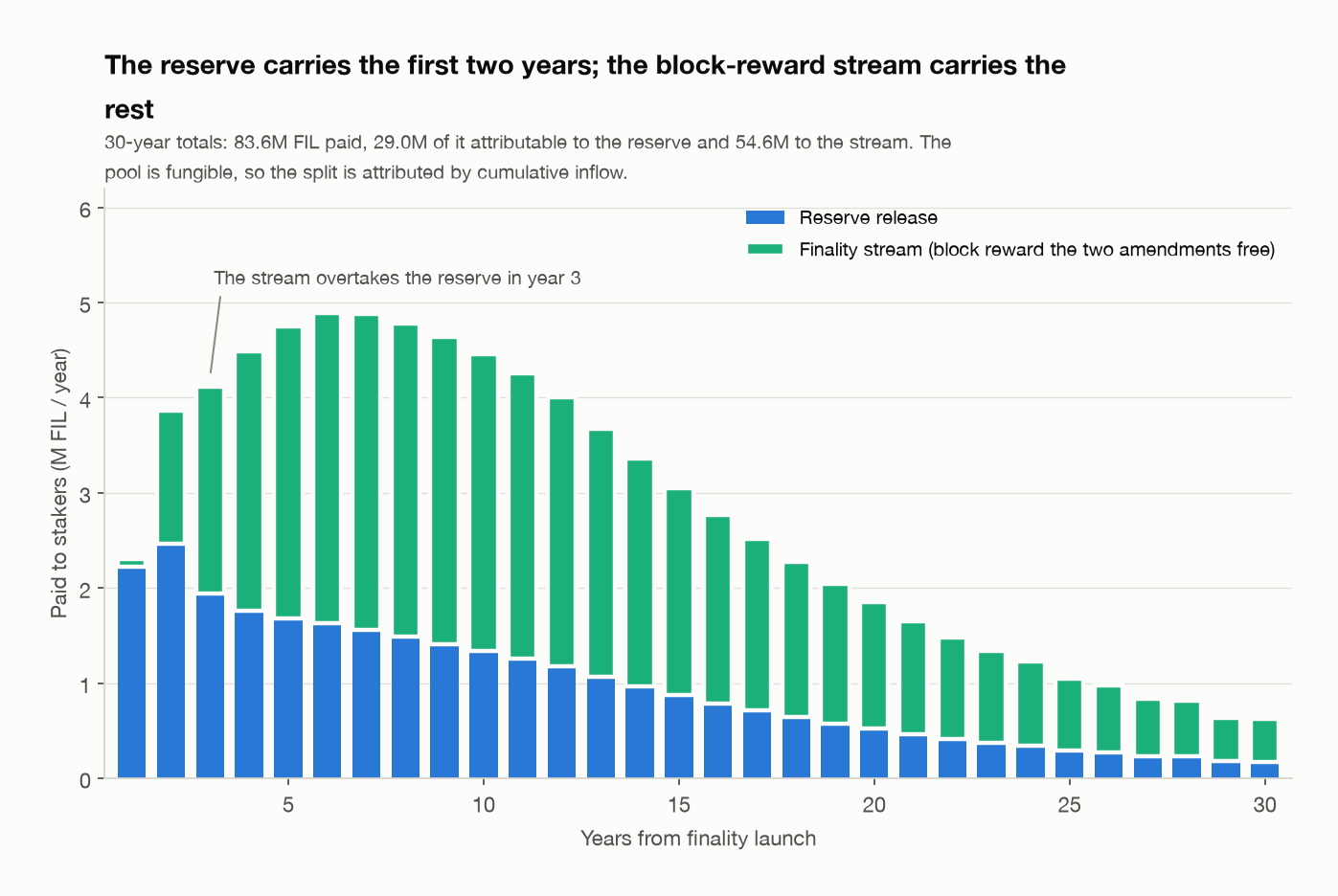
The reserve carries the first two years; the block-reward stream carries the rest and overtakes it in year 3.
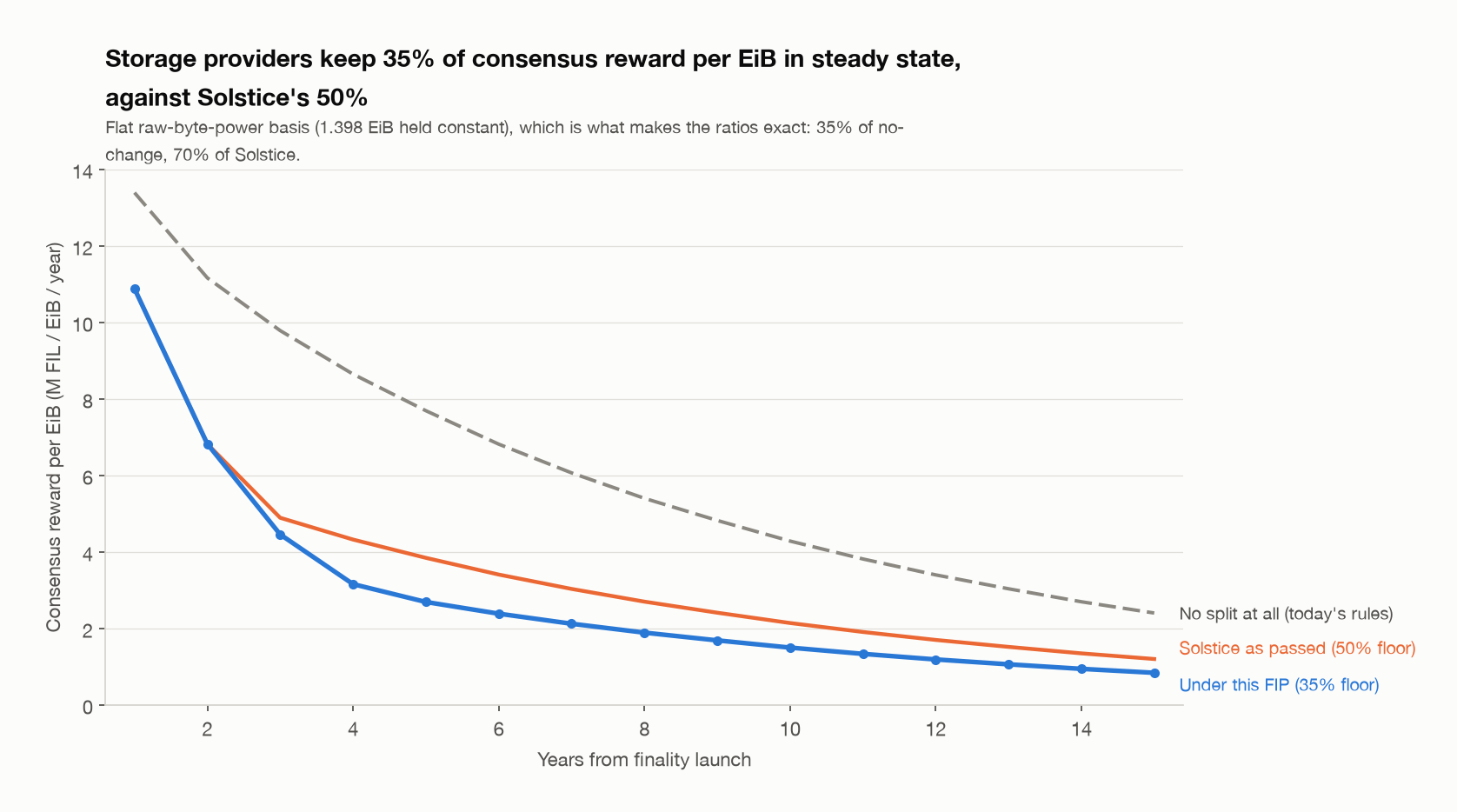
Per-EiB consensus revenue settles at 70% of Solstice’s level and 35% of the no-split level at a 35% floor. At a 30% floor it is 60% of Solstice’s, at 25% it is 50%, and under the reserve-only option it is unchanged from Solstice.
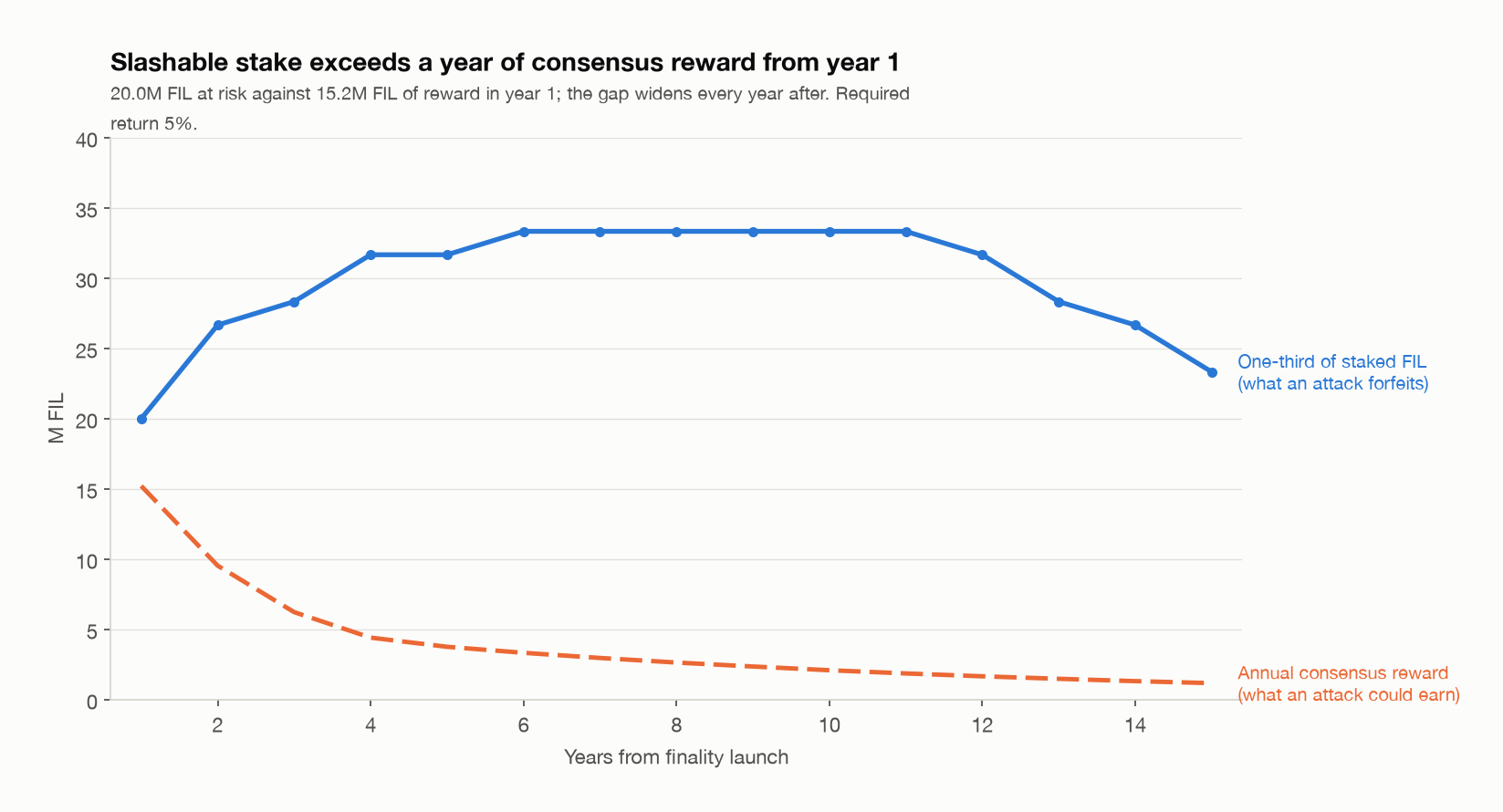
Slashable stake exceeds a full year of storage-provider consensus reward from year 1, 20.0M FIL against 15.2M, and the gap widens every year after.
5. What a staker and a storage provider see
Both run the worked scenario from section 2.
A staker
You stake 10,000 FIL in month 10 after finality launches, when 50M FIL is staked network-wide. The pool holds close to its 30M FIL launch balance, and the posted rate at that depth is 6.29%. Held still for a year, that is about 629 FIL, gross of the includer share paid to whoever submits the certificate and of the gas you pay to claim.
The rate does not hold still, and it is the same rate for everyone. Two things move it. More stake lowers it: at the launch pool, 80M FIL staked posts 4.89% and 100M posts 4.26%. A fuller pool raises it: by year 6 the pool has grown to 34.15M FIL, where 80M staked posts 5.57%. In the 5% case the two effects settle against each other, and from year 2 through year 14 the posted rate stays inside 4.0–5.0%. Staking early does not lock in a rate, and waiting does not improve one. The opening rate sits exactly on its 12% ceiling with no headroom above it.
| Total staked | 0 | 25M | 50M | 80M | 100M | 130M | 200M |
|---|---|---|---|---|---|---|---|
| Posted rate at launch, pool 30M FIL | 12.00% | 8.25% | 6.29% | 4.89% | 4.26% | 3.57% | 2.59% |
| Posted rate in year 6, pool 34.15M FIL | 13.66% | 9.39% | 7.16% | 5.57% | 4.85% | 4.06% | 2.95% |
A storage provider
Consensus revenue per EiB, on a flat 1.398 EiB basis and the section 3 timeline (finality launch 2027-03-01). Years 1 and 2 are identical to Solstice because the published ramp is untouched and the continuation has not started.
| Year | Under this design, 35% floor | Solstice as passed, 50% floor | No split at all |
|---|---|---|---|
| 1 | 10.881 | 10.881 | 13.393 |
| 2 | 6.823 | 6.823 | 11.165 |
| 3 | 4.458 | 4.894 | 9.787 |
| 5 | 2.692 | 3.846 | 7.693 |
| 10 | 1.500 | 2.142 | 4.285 |
Units are M FIL per EiB per year. In steady state the ratios are exact: 35% of the no-split level and 70% of Solstice’s. Over thirty years storage providers receive 67.991M FIL of consensus reward, against 84.197M under Solstice as passed. A 30% or 25% floor takes the steady-state ratio to 60% or 50% of Solstice’s and costs storage providers more over the thirty years; the reserve-only option costs them nothing.
The quarterly steps are smaller than the ones already published. The sharpest quarterly drop in per-EiB consensus revenue anywhere in the combined schedule is 12.44%, and that is a step the published ramp already takes. The continuation below 50% moves 2.5 points a quarter, so every quarter it adds is a smaller step than the ones Solstice already commits to. No quarter breaches a 15% guard.
Staking is open to storage providers on the same terms as anyone else: the posted rate is uniform across participants, and an SP that holds idle FIL can stake it for finality without touching sectors, pledge, or block production. Block producers additionally earn the includer share for submitting certificates on chain.
6. FAQ
How much comes out of the reserve, and why spend it at all? Between 48M and 91M FIL, in one transfer at the upgrade epoch, against a capped envelope. The reserve holds 282.93M FIL, so that is 17% to 32% of it. The preferred option is the 91M end, where the reserve pays for everything: it is FIL set aside at genesis for new miner types, no FIP has ever drawn on it, and spending it asks nothing of anyone already being paid. It costs about twice the draw and more than three times the first-decade issuance of the cheapest option. FIP-0118’s Design Rationale Q3 sets the reserve aside as finite and non-renewable, which is an argument for drawing on it carefully rather than never: one transfer, under a written ceiling, released on a fixed schedule, and a sunset that burns whatever is never paid. The options that open a stream draw less and pay for it out of someone’s share.
If the pool pays stakers every year, how can total FIL entering circulation fall every year? Because what the pool pays is small next to what the consensus stream gives up over the same period, and block reward itself is declining on the existing minting schedule. In year 1 storage-provider consensus reward is 15.212M FIL and payments to stakers are 2.300M. By year 6, when payments peak at 4.890M, consensus reward has fallen to 3.336M. FIL entering circulation falls in every year of the thirty, at both required-return cases and under every funding option, including the reserve-only one at 91M FIL. The figures here are the worked scenario’s, where the early falls are the large ones: 3.65M FIL from year 1 to year 2 and 3.54M from year 2 to year 3 at a 5% required return. Even the flattest year still falls, by 0.059M FIL at 5% and 0.125M at 3%, and there is no rising year. Year 4 runs 0.165M FIL below today’s committed curve.
What happens if a huge amount of stake signs up at once? Is there a cap, and does early signup activate finality sooner? There is a cap, and it binds whatever arrives: in any year the pool can pay out at most a fixed fraction of what it currently holds, 22% in the worked scenario, which is 6.60M FIL in year 1 on the 30M FIL released at launch. A rush cannot overshoot the pool, because the payment is a rate on the pool and a larger stake lowers the rate one-for-one. At a 5% required return, stake above 77M FIL posts under 5% at the launch pool, so the next FIL in stops arriving, and stake above 110M FIL posts under 4%, so stake starts leaving. The modeled peak is 100M FIL. Early signup does bring activation forward, because the mechanism FIP’s activation gate reads stake depth and distribution rather than a calendar; at the modeled 5M FIL per month it takes sixteen months of uninterrupted inflow to reach 80M FIL.
When does the consensus reward reach its floor? Under the preferred option the storage-provider share stops at Solstice’s published 50% floor and the continuation never starts. Where a stream is opened, the floor lands six quarters after the end of Solstice’s published ramp at 35%, which on the modeled dates is 2030-09-01, three and a half years after finality launch. A 30% floor takes eight quarters and a 25% floor ten. The 50% waypoint is 2029-03-01 under every option, and all of these dates move with activation.
Doesn’t the falling-issuance claim depend on how circulating
supply is defined? Yes. The netting amendment is the accounting
change the analysis recommends: FIL sitting in the pool is not counted
as circulating until it is paid out. Under it the design runs +10.9M to
+38.8M FIL above today’s committed curve over the first decade depending
on the option, +12.61M in the worked scenario. Without the amendment,
the whole transfer lands as a single step in the year it happens, and
both the decade and the thirty-year figure become the size of that
transfer. Issuance still falls every year in that world, because the
step lands in year 1. What breaks without the amendment is the
comparison against today’s committed curve; the shape of the curve is
the same either way. Staked FIL is a separate question and the answer
there is no: staked FIL keeps counting as circulating, as it does on
every other chain, because FilCirculating is a consensus
input that sets the per-sector pledge lock target.
Why would the service cap move at all, when FIP-0118 says 50%? Only if the stream is opened. It is paid last: service is computed as if the stream were absent and is never reduced by it, so service receives the same FIL over thirty years with the stream as without it. The stream lives on the residue, and the size of that residue is what decides whether the reward can recruit stake at all. At the published 50% cap the residue never grows enough and stake never reaches the 80M FIL security level at a 5% required return, which is why the preferred option leaves the cap alone and the reserve pays for everything. Where the cap lands if it does move, 35% or 40%, sets how much of the bill the stream carries and therefore how much smaller the reserve draw can be.
What if participation is weaker than modeled? Each row below changes one assumption in the worked scenario and holds everything else, including the size of the transfer. The count is contiguous years at or above 80M FIL. The options in section 2 respond to a higher service cap by drawing more from the reserve instead, which is what keeps every one of them at twelve years or more.
| Stress | Contiguous years | Entry year | Peak stake | Issuance still falls every year |
|---|---|---|---|---|
| Central case | 13 | 2 | 100M | yes |
| Service entitlement 30% | 11 | 3 | 90M | yes |
| Service entitlement 35% | 9 | 4 | 85M | yes |
| Service entitlement 50% | 0 | — | 75M | yes |
| Required return 5.5% | 10 | 4 | 90M | yes |
| Required return 6% | 7 | 6 | 80M | yes |
| Gas burn 1M / 3M / 6M FIL per year | 13 / 13 / 13 | 2 | 100M | yes |
| Finality launch slips to 2028-04-01 | 12 | 2 | 100M | yes |
Gas burn does not matter at all, because the release table is a fixed vector and nothing in the funding path reads chain state. A slipped launch costs one year. At a fixed transfer the service cap decides everything: at 50% the pool never reaches the security level, which is why the preferred option is sized around a larger transfer, the 91M FIL envelope.
7. Formula appendix
The posted rate.
r(S, P) = spend_rate × P / (S + S_offset)with the worked scenario’s spend_rate = 0.22 per year
and S_offset = 55M FIL [strawman]. S
is total staked FIL and P is the released, spendable
balance of the reward pool. Each year the pool offers a fixed fraction
of what it currently holds, divided across the FIL staked plus a
constant that keeps the rate finite when almost nothing is staked. More
stake lowers the rate; paying rewards lowers the pool and lowers the
rate again. At launch, with 30M FIL released and nothing staked, this
reads 0.22 × 30 / 55 = 12.00% exactly, so the opening rate sits on its
ceiling with no headroom.
The two constants move together and they move with the funding envelope, so each option in section 2 carries its own pair, chosen with the envelope. Two things hold in all of them: the opening rate sits at or just under a 12% ceiling, and the posted rate stays in a 4–5% band while stake is at or above the security level. The worked scenario’s pair puts the opening rate exactly on the ceiling; the adopted pair leaves headroom below it, so publication rounding cannot breach it.
The stream weight.
service share  = min(cap, service entitlement)       # computed as if the stream were absent
finality share = 1 − storage-provider share − service share
with a flat 0.45 record for the finality stream [strawman], which the residue never reaches at any cap and floor in the option set. Storage providers are paid their scheduled share first, service is paid its entitlement up to the cap and is never cut to make room, and the finality stream takes what remains. Because the remainder tops out at 40%, the stream’s own record never binds and no block reward goes unallocated.
The release rule.
release(y) = scheduled simple minting in year y−1 − scheduled simple minting in year ywith 30M FIL released to the pool at launch in the worked scenario and the table summing to 18.4391M FIL as tabulated (18.43919M exact) over years 1–30 [needs precise spec: the final table for the adopted envelope, the epoch within each year at which the release lands, and the fixed-point representation]. Each year the pool receives the amount by which the existing minting schedule shrinks that year. Those amounts are known in advance and depend on nothing that happens on chain, so the schedule ships as a constant vector in the actor and no gas-burn or network-growth path can change it. The rule is that the adopted table releases the whole transfer across the thirty years, which is worth about one more year at or above the security level than a table that strands part of it. The worked scenario’s table is drawn before that rule and leaves 1.350M unreleased; whatever is left in the pool at the year-30 sunset burns.
A release-on-need variant, which releases each year only what the pool is short of its launch level, was evaluated and set aside. It returns one more year at or above the security level at the central 5% case and defers about 5M FIL of first-decade issuance, but the extra year exists only if the market clears at 5% or below: above that the pool never rises far enough above its launch level to hold the 80M FIL security level at all. The full comparison is in the funding model’s release-on-need runs (unpublished, available on request).
Public records referenced
FIP-0118 (Solstice), Design Rationale Q3, “Why not the f090 mining reserve?”; FIPs discussions #1249, #887, and #1030.